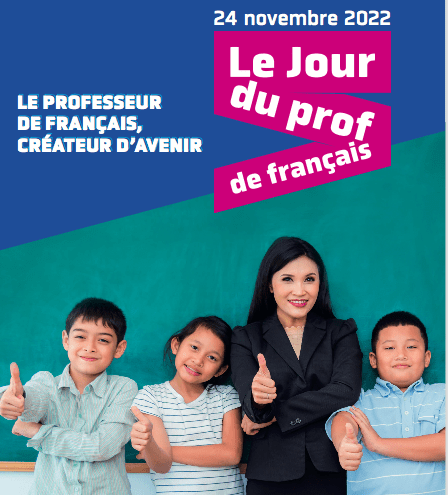
November 24, French Teachers’ Day… Shapers of the Future.
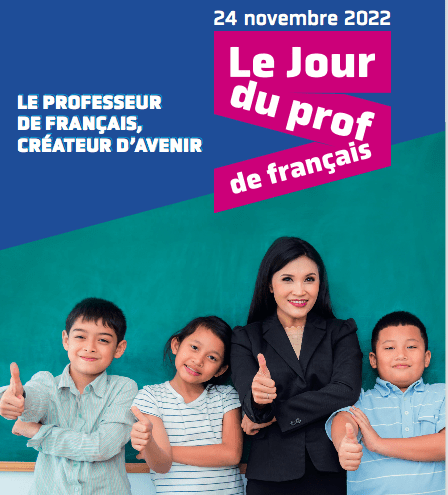
This date has been observed since 2019 at the initiative of the FIPF, the International Federation of French Teachers. There are 900,000 of us French teachers, spread across five continents, teaching the language of Molière with passion and dedication.
Here is the official message from its president, Cynthia Eid:

Here is what we read in the introduction to this very special day dedicated to our profession:
“French teachers do more than just teach a language; they are also shapers of the future.
In some countries, this may involve how the French language is perceived—whether at the school level, city level, or nationwide… or how French teachers and their associations inspire new generations to learn French. It can also be about how educational authorities view and support the teaching of French, or how French teachers and their associations engage with these authorities and help shape a new future for French education.”
While there is no doubt about the teachers’ mobilization, and while the stated political will seems clear and particularly aggressive, what is the reality on the ground?
For instance, we saw the President of the French Republic make a new commitment last week, in the spirit of “reconquest”…
But beyond good intentions, the AIFP video addresses our profession’s ability to hold political authorities accountable for the commitments they may have made at a given time. Here, then, is a text written by Mr. Crispin Mujanayi, a teacher in Kinshasa and administrator of a large group of French teachers, which speaks volumes about the gap that sometimes exists between words and deeds: " In accordance with the 2017 inaugural address of the President of the French Republic, the global influence of the French language can only be achieved if teachers have the necessary resources—both in terms of facilities (language labs, libraries, lecture halls, audiovisual equipment, etc. ) as well as for the operation of teaching units in schools, the organization of professional development seminars for French teachers in all countries, and collaboration among various groups of French teachers.”
In the turbulent times in which we currently find ourselves, there is no doubt that French teachers around the world are helping to strengthen the fourth pillar of the Objectives of La Francophonie (OIF), namely “promoting peace, democracy, and human rights.” Thus, we do not know what seeds we are sowing here and there when we share the French language with current or future generations of Francophiles. Will there be, in 10, 20, or 30 years—in a place near or far—a story like the one I’m about to tell you here:
This took place 25 kilometers from my home, in a small seaside town called Pornic. In late August 1944, while the Germans were suffering a general rout throughout France, here they continued to hold their positions in what was known as the Saint-Nazaire pocket. I’ll let our local expert, Michel Gautier, describe the event in detail: “The day of August 26 arrived. At 8 a.m., the mayor of Pornic, Fernand de Mun, received a call from German Commander Meyer, who was in control of the town of Pornic. Two German soldiers had reportedly been killed and an officer wounded during the night while searching for a Pornic-based resistance fighter, Maurice Pollono. In reality, only one officer had actually been wounded, but Captain Meyer announced severe reprisals: the town would be blockaded, and the municipality was ordered to compile a list of 20 hostages until the “terrorists” responsible for these events turned themselves in.”
What is important to note is that at the time, there had been meetings between Rostislav Lukianov, a photographer based in Pornic, and his compatriot, Major Potiereyka—a colonel in the Vlasov Army, who, like him, was born in Kiev and commanded a squadron of the 752nd Artillery Battalion of the Osttruppen, part of the 275th German Infantry Division stationed in the Pornic area at the time the southern pocket of Saint-Nazaire was forming.
It was therefore Raymonde Loukianoff, his wife, who intervened with the major to secure the hostages’ release: “Just past noon, she put Boris in his stroller, reassured Yannick, and walked down to the port with her children, along with hundreds of Pornic residents responding to Meyer’s ultimatum to gather at Place du Môle. Any resident of Pornic who denounced anyone who had acted against the Germans would secure the release of one of the 20 hostages at the square. If no one was named, ‘the city would be set ablaze at all four corners.’ Very quickly, the list of hostages is drawn up: the mayor, the deputy mayor, city council members, and even the parish priest, among others, volunteer, and Meyer completes the list. At 1:00 p.m., as agreed, the crowd is gathered, terrified, with German cannons and machine guns trained on them.”
The epilogue to this story would not unfold until the following day, after hours of excruciating anxiety during which negotiations led to the hostages’ release and then the final departure of the unit commanded by Meyer…
What does this have to do with our topic of the day, you might ask? Well, perhaps the fact that Raymonde Loukianoff was able to communicate in Major Potiereyka’s language and that he was a Francophile…
Here is the link to the website that tells the full story:
http://chemin-memoire39-45paysderetz.e-monsite.com/medias/files/raymonde-loukianoff-figure-discrete-de-la-resistance-pornicaise.pdf
Foreign language teachers, regardless of the language they teach, are potential agents of peace—sometimes without even realizing it—so let them be given the means to foster multilingualism and cultural openness toward others.
And finally, for those who have read this long article all the way through, here is the ultimate reward: a magnificent tribute by Dany Laferrière, writer and member of the Académie française, to his own French teacher: